West Country Violins

Bow information page

This article is designed to help you understand the very complex subject of French violin bows from around 1880 until the 1980s. Unlike violins which are normally either made by a particular maker and labelled or branded as such or are workshop instruments which are also often labelled as being “of the atelier” or “finished and sold by”, bows are much more complicated.

A very large percentage of bows made by a particular maker will carry the brand of someone else. Sometimes this brand will be of another bow maker but more often than not it will be a violin maker, a dealer or sometimes a fictitious model name. This situation may lead you to think that once you know who the bow maker supplied you would consequently know which brands would appear on his bows! Alas it is not that easy as several bow makers would supply the same buyer! Perhaps before we go further an example might help:
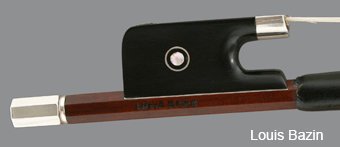
One of the best and most prolific makers was Charles Louis Bazin. He made bows for at least 16 violin makers including Paul Buescher, Albert Deblaye and Roger & Max Millant. It just so happens that Morizot Frères also made bows for the above three violin makers.  In each case the violin making firm would purchase the bows without stamps and then apply their own: this is why there is so much confusion as to actual provenance. As you can see from the above example, a bow stamped Paul Buescher could have been made by either C.L.Bazin or Morizot Frères or one of the lesser known makers all of whom were supplying bows at the time.

The actual maker of the bow is ascertained by careful examination of certain features, such as the shape of the head, length of stick, dimensions of the frog and then finer details which help to establish as to whether the bow is a workshop bow made by assistants or made by the master himself. These include such details as the type of joint used in the heel plate (is it bent from one piece or is it joined at the angle), the number of pins in the heel plate and in the underslide. The diameter of pearl eyes and rings, the number and dimensions of the winder rings, type of thread used and so on. As you can see it takes considerable knowledge, comprehensive reference books and a feel for the bows of the period.

Which bow should you buy?

The old French mid priced bows can be very good value for money and are usually genuine. No one is going to bother to fake a J.T.L. bow or L.Morizot for example. For most people the confusion arises because of the stamp. In my experience it is the higher price range bows that can sometimes be questionable and are more likely to be subject to  either faking or sometimes just a very good modern copy. Makers such as Vigneron, Thomassin, Fetique and Peccatte have all been treated this way.
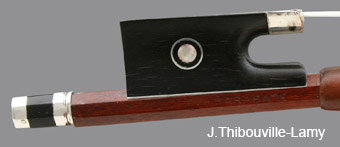
Jerome Thibouville-Lamy workshops
The least expensive bows that can be considered as from a known source or maker are the J.T.L. bows. The Jerome Thibouville-Lamy workshops had their own bow makers who produced a range of qualities, they are good intermediate bows signed with a variety of stamps such as Grandini, Buthod, Duchene, Lupot, Vidoudez, J.Lamy and several others. They also bought many bows from the Bazin workshops.

With all the dedicated bow makers, you find both workshop bows (made by the maker’s assistants) and you have bows made in part or entirely by the maker himself.  The following, in no particular order, are some of the well-known families in French Violin Bow making.  Almost all also made bows for violas, cellos and double basses as well as for the violin.
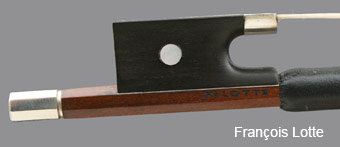
François Lotte, born 1889 died 1970
François Lotte was the father, with Roger François Lotte carrying on his father’s work. All the fine quality bow makers sold their bows stamped with their name or model name as being their best quality but they also sold bows unstamped to dealers who would then apply their own stamp: this is one of the reasons there is so much confusion as to who actually made a particular bow. François Lotte worked for,  amongst others, Apparut & Hilaire, Paul Serdet,  Marcel Vatelot and Roger & Max Millant. Therefore any of these names can appear on a François Lotte bow or his own name, François Lotte.
Roger François Lotte born 1922 died 1989
Roger François Lotte (the son of François Lotte) made bows for: George Deblaye, Dupuy,  Léon Mougenot and also Roger & Max Millant amongst others. His best bows made entirely by himself are stamped: Roger François Lotte and sometimes Roger Lotte. Bows by both the father and the son are increasing in value quite rapidly. At the time of writing this article in 2009 the Lotte bows have increased in value by well over 100% in five years.
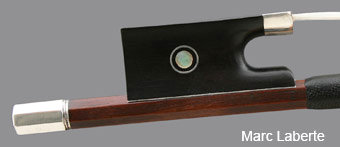
Marc Laberte
In a similar price range and quality, there are the Marc Laberte bows. Marc Laberte started producing excellent bows from around the 1920s until 1960. The best bows were branded Marc Laberte or Laberte and also a workshop model branded V.J.Ferelli. The silver mounted examples are very good bows and well worth considering.
Louis Joseph Morizot born 1874 died 1957

Louis Joseph also known as Morizot père was the head of the Morizot family. He began his training with Cuniot-Hury then Charles Nicolas Bazin and finally worked for the famous Sartory. He set up his own workshops at the end of the first world war in Mirecourt where he worked alone producing excellent bows until his sons began to assist him in 1920. He had many clients who applied their own stamps to his bows including: Joseph Aubry, Charles Bailly, Fernand Bilottet, Cone, Collin Mezin even Victor Fetique to name just a few. In about 1933 he formed a partnership with his sons, the firm was known as: Louis Morizot fils.

Louis Joseph had six sons, René who became a violin maker. The other five sons: Paul Charles, Louis Gabriel, André Auguste, Paul Georges and Marcel Louis all became bow makers and were all trained by their father and worked together with him; they became known as “Morizot Frères”. They worked for: Joseph Aubry, Paul Buescher, G.Cone, Davot, Deblaye, R & M Millant, Daniel Moinel and many others. Their own stamp was: L.Morizot. Their bows are often referred to as bows by “Morizot Frères”.  His better quality bows usually have rounded heels to the back of the frog.
The Bazin family of bow makers

The modern Bazin makers, and by modern I mean from 1860 until 1980, were descended from François Xavier Bazin; François Xavier died of Cholera in 1865. His son was Charles Nicolas Bazin; his son was Louis Bazin and his was Charles Alfred Bazin. Bows by Charles Nicolas are fine bows and much sought after, they command a higher price than bows from Louis or Charles Alfred, mainly because of the quality of the sticks  and antiquity. He produced a lot of  bows and worked for amongst others: Audinot, Paul Blanchard, E.Bouulangeot, Charles Brugere, Caressa & Français, G.A.Chanot, Collin-Mezin, Courvisier, Curtil, Darches, Diens, J.P.Diter, Fallise, P.Lorange and several others, in addition he stamped his own bows: Bazin, C.Bazin, Tourte, Tourte.L, Lupot, Maire, Tubbs, Pajeot etc.. Bows by Charles Nicolas are much sought after, the sticks are very good quality and produce a clear tone with good power.

Next is Louis Bazin. He served his apprentiship with his father above. Took over his father’s business in 1907 but was called to serve in the 26th. Infantry Regiment World War 1. After the war he returned to bow making and by 1921 had eight workers in his Mirecourt workshops. In 1922 he took on his son Charles Alfred. Louis worked until October 1952 and died in November 1953. He worked for G.Apparut, Jenny Bailly, Léon Bernardel, Paul Buescher, L.Courtier, Albert Deblaye, J.Hel, M.Laberte, J.Lavest, A.Lorenzi, R.& M. Millant and Marcel Vatelot among others. His own stamp is Louis Bazin. They are fine bows, they produce a classy refined tone, some people think they are a little soft in tone but it depends on the bow, some are quite soft in sound others can be quite strong, they are becoming a very good investment as the prices are still quite reasonable at the present time.

Finally we come to Charles Alfred Bazin. Son of Louis, he started his apprenticeship on September 1st. 1922 and soon became Louis’ right hand man. He was inspired by his father’s style  which he enriched with his own personality, he loved to work in gold. He took over his father’s business in 1952. He worked for Paul Bisch, Coné & Fils, Dupuy and Millant. His own stamp was Charles Bazin, C.Bazin with the cross of Lorraine on either side and Charles Bazin France. Fine bow sticks of good density are sometimes quite slender. He tended towards round heels to the frog and parisien eye although he also made bows with a square heel.
Emile François Ouchard

Also known as Ouchard Peré he started his apprenticeship with Eugène Cuniot in 1886. He set up his own workshops in 1923 in Mirecourt. From this point his work is branded Emile Ouchard, before this date he was using the Cuniot-Hury brand. By 1936  he had fifteen skilled workers in his premises including his son Emile Auguste Ouchard. His bow sticks are fine quality, of an orange/brown or dark brown colour and usually of good density. He worked for Aubry, Bisch, Coné, Cuniot-Hury, Charles Enel, Nicolas Le Maire and others.

His son Auguste took over  the business in 1937 and then moved to Paris. He spent 13 years in the U.S.A. as a bow maker for William Lewis and Son in Chicago on an annual salary of $10,000, good money in 1948!.  His bows have mainly square heels with Parisien eyes to the frogs and with quite straight lines to the head. Bows by Emile Auguste Ouchard are very similar in style to his father’s, he continued making bows until his death in 1969. His golden period is between 1940 and 1960. His bows are very lovely and much sought after. His own brands were E.A.Ouchard Fils, E.A.Ouchard Paris, Emile A. Ouchard New York, and Emile A. Ouchard. He worked for a prolific number of violin dealers and makers, just a few are Aubry, Beuscher, Billottet, Chanot & Chardon, Claudot, Emile Français, Paul Lorange, Marissal, Roger & Max Millant and others.
Eugène Cuniot, known as Cuniot-Hury
This will be the last maker I will cover in this article. Eugène Cuniot studied under his father and then took over the firm at an early age following his father’s death in 1884, Eugène was only twenty two at the time. He was greatly influenced by the style of C.N.Bazin which can be seen in his frogs and buttons although he kept his own originality in the heads. In 1901 he was employing 7 workers, this became 12 in 1906. He made fine bows with good balance. His brand was Cuniot-Hury or C.H. with a decorative  mark each side, a bit like a treble clef on its side. He worked for among others, Paul Buescher, Collin-Mezin, Diens, Gauthier, Guarini, Joseph Hel, Paul Jombar, Paul Lorange, L.Mougenot and Paul Serdet.
We hope this article will go some way towards explaining an intricate and difficult subject and to help you make a decision as to which bow to buy. All of the above makers represent a good investment: their bows will only go up in value. We usually have several examples of these makers’ bows for sale on this site but our prices are low and so our stock sells quickly! If you don’t find what you are looking for please come back soon or send us an email.


Lower Price Bows | Mid Price Bows | Higher Price Bows | View All Bows | Return to Store | Contact Us